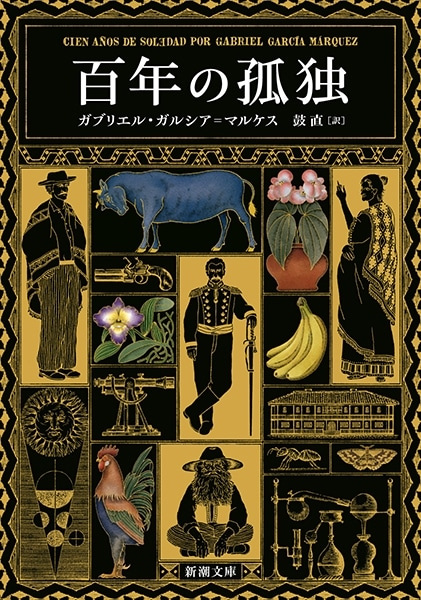
The Buendía Family Tree (Poster)

About the Novel
Author: Gabriel García Márquez / Original Title: Cien años de soledad / First Published: May 30, 1967 (Buenos Aires, Argentina — Editorial Sudamericana) / English Translation: 1970 (translated by Gregory Rabassa) / Award: Nobel Prize in Literature, 1982 / Copies Sold: Over 50 million / Translated Into: More than 46 languages
Author Gabriel García Márquez was born on March 6, 1928, in the small Colombian town of Aracataca. He spent his early childhood with his grandparents, and his grandmother’s way of telling stories is said to have deeply shaped his later style. He began his career as a journalist, and devoted himself to writing this novel from around 1965. By the time he finished the manuscript in August 1966, he was reportedly deep in debt. In 1982, he was awarded the Nobel Prize in Literature, largely on the strength of this work. The novel is widely regarded as a defining book of the 1960s–70s “Latin American Boom.”
Chronology of Macondo (Mapped to the Novel's 20 Chapters)
The Founding of Macondo
A band of settlers crosses the swamps and builds a village — an isolated utopia not yet marked on any map.
Contact and Development
The magistrate Moscote, the merchant Pietro Crespi, and the priest Nicanor arrive one after another, bringing government, trade, and faith to Macondo.
The Civil War
Colonel Aureliano rises up as a Liberal rebel. Thirty-two armed uprisings unfold, along with the tragedy of his many illegitimate sons — echoing the real Thousand Days’ War (1899–1902).
Expansion and Calm
A period of postwar rebuilding, as a new generation grows up within the house.
The Banana Boom
The railroad arrives, and an American banana company brings a wave of prosperity to the town.
The Massacre
A workers’ strike ends in a massacre erased from memory.
Four Years of Rain
A legendary deluge accelerates the town’s decline.
Decline and the End
Sealed off from the outside world, the house quietly crumbles as the prophecy comes true.
The Buendía Family Tree — Character List
José Arcadio Buendía
Patriarch, Founder of Macondo (The Obsessive Inventor)
A patriarch consumed by alchemy and invention. Obsessed with the outside world’s marvels — ice, magnets, telescopes — he eventually crosses the border of reason and spends his final years tied to a chestnut tree in the courtyard. At his death, a light rain of tiny yellow flowers falls over Macondo.
Úrsula Iguarán
Matriarch (Guardian for a Century)
The longest-lived member of the family, and the household’s true backbone for most of the story. Her lifelong fear of inbreeding finally comes true in the last generation.
Rebeca
Adopted Daughter (no blood tie) (The Earth-Eating Orphan)
An orphan who arrives in the village clutching a sack containing her parents’ bones. She is said to have brought with her both an insomnia plague and a strange habit of eating earth. In old age she shuts herself away in the house for the rest of her long life.
José Arcadio
Eldest Son (The Wandering Strongman)
Enormous in strength and restless by nature, he runs off with a band of gypsies as a young man. Years later he returns as a giant of a man and startles everyone by marrying Rebeca, the family’s adopted daughter. He dies under mysterious circumstances in his later years.
Pilar Ternera
Fortune-Teller, Mother of Two Sons (Reader of Fates)
One of the original settlers who founded Macondo, brought there by her parents to separate her from a difficult past. She becomes the woman who reads the family’s fate in cards for decades. She bears sons by both José Arcadio and Colonel Aureliano, yet never formally marries either. She lives to an almost impossible old age.
Colonel Aureliano Buendía
Liberal Rebel Leader (Thirty-Two Uprisings)
Leader of thirty-two armed uprisings, losing every one yet somehow surviving them all — the most legendary figure the family produces. In his later years he withdraws from war entirely, spending his days in his workshop casting tiny gold fish, only to melt them down and start again.
Remedios Moscote
Colonel Aureliano’s First Wife (A Short-Lived Bride)
The youngest daughter of Macondo’s magistrate, Moscote. She is engaged to Aureliano while still a child and marries him shortly after coming of age. Beloved by the household, she dies suddenly of an unexplained illness while pregnant with twins.
Amaranta
Youngest Daughter (She Refused All Love)
She never marries, living out her life consumed by jealousy and regret, endlessly weaving her own burial shroud. Her lifelong refusal of love makes her one of the clearest embodiments of the family’s solitude.
Arcadio
Interim Ruler, Dictator (The Cruel Dictator)
Left in temporary charge of Macondo during wartime, he swiftly becomes a brutal dictator. Unknowingly drawn to his own mother, Pilar Ternera, he is deceived into sleeping with Santa Sofía de la Piedad in her place to avoid incest. He is captured and executed by firing squad — his twins are born only after his death.
Santa Sofía de la Piedad
Woman Who Married Into the Family (The Silent Mother)
Becomes Arcadio’s common-law wife, quietly running the household for decades. In old age she leaves the house without a word to anyone.
Remedios the Beauty
Daughter of Arcadio and Santa Sofía (The Beauty Who Ascended)
An unguarded, free-spirited beauty whose otherworldly looks lead man after man to their deaths, though she herself has no worldly desires at all. One day, while folding laundry, she simply ascends into the sky, wrapped in a bedsheet.
José Arcadio Segundo
Labor Strike Leader (One of the Twins) (Witness to the Massacre)
Organizes a strike among the banana plantation workers and becomes the sole survivor and witness of the massacre that follows. Unable to convince anyone it happened, he spends his final years absorbed in decoding Melquíades’ parchments. He dies on the very same day as his twin brother.
Aureliano Segundo
Pleasure-Seeker (One of the Twins) (The Endless Reveler)
A hedonist who throws lavish parties fueled by the banana boom’s wealth, balancing a household with his wife Fernanda alongside a freewheeling life with his mistress Petra Cotes. He dies on the very same day as his twin brother.
Fernanda del Carpio
Woman Who Married Into the Family (The Rigid Outsider)
Born into a fallen aristocratic family, she brings rigid, formal discipline into the Buendía household. She never once bends to Macondo’s ways, and rules over the family through its long decline.
The Seventeen Aurelianos
Illegitimate Sons of Colonel Aureliano (Cursed by the Ash Cross)
The illegitimate sons Colonel Aureliano fathered with various women during the war. Each is marked with a cross of ash at baptism and formally recognized by the family. All but one are later assassinated, one by one, casting a long shadow over the Colonel’s final years.
Aureliano José
Soldier (An Unrequited Love)
Carries an unrequited love for his aunt Amaranta into his military service, and dies young in battle.
José Arcadio (the Younger)
Son of Aureliano Segundo and Fernanda (A Failed Seminarian)
Sent to seminary in Rome at his mother’s insistence, he returns home without ever taking orders. He dies in the bathroom of the family home.
Renata Remedios “Meme”
Daughter of Aureliano Segundo and Fernanda (A Love Torn Apart)
Falls in love with the mechanic Mauricio Babilonia, but her strict mother Fernanda tears them apart, sending her off to a convent while pregnant.
Mauricio Babilonia
Mechanic (Outsider) (The Lover Who Was Shot)
Yellow butterflies always flutter around him, and Meme learns to sense his presence by their appearance even when she cannot see him. He falls in love with Meme, but is shot after being mistaken for a chicken thief, and lives out the rest of his life with a broken body.
Amaranta Úrsula
Youngest Daughter of Aureliano Segundo and Fernanda (Returned From Abroad)
Studies abroad in Brussels and returns with a modern sensibility, determined to restore the crumbling family home. Unaware of the blood tie, she falls in love with Aureliano (Babilonia), her own nephew.
Gastón
Amaranta Úrsula’s Husband, an Aviator (The Aviator Who Never Returned)
A wealthy Belgian aviator. He meets Amaranta Úrsula after flying his biplane over the convent school where she studies in Brussels, and the two marry. She leads him back to Macondo as if on a silk leash. He tries to start an airmail service, but grows impatient waiting for his biplane, which is mistakenly shipped to a tribe in Africa. He returns to Belgium to track it down — and never comes back.
Aureliano (Babilonia)
Son of Meme and Mauricio (Reads the Parchments)
Raised in secret within the depths of the house, his origins hidden from him, he immerses himself in books and in Melquíades’ parchments. Unaware they are related, he is drawn to his aunt, Amaranta Úrsula.
The Last Aureliano
Son of Aureliano (Babilonia) and Amaranta Úrsula (Born With a Pig’s Tail)
The only child in the family ever born of love — and yet, because of the incestuous blood running through him, he is born with a pig’s tail. Carried off by a swarm of ants moments after losing his mother, his death marks the end of the family line.
Melquíades
Gypsy Sage and Prophet (Wrote the Prophecy)
An elderly gypsy who visits Macondo each year with a traveling show, bringing wonders of the outside world — magnets, telescopes, ice — and forming a close friendship with José Arcadio Buendía. Though he is once reported dead, he cannot bear the solitude of death and returns to Macondo. Later, he drowns in a river and becomes the first person buried in Macondo, yet continues to appear from time to time even after death. The prophecy he wrote in Sanskrit is finally deciphered by the family’s very last generation.
Colonel Gerineldo Márquez
Aureliano’s Comrade-in-Arms, Revolutionary (The Unrequited Comrade)
Colonel Aureliano’s comrade through all thirty-two uprisings. Left in charge of Macondo’s military government, he is nearly ordered executed by Aureliano himself over a peace treaty dispute. He courts Amaranta for years, and is refused to the very end.
Visitación
Indian Servant Who Fled to Macondo (The Woman Who Brought the Plague)
Fleeing an insomnia plague in her own homeland, she arrives in Macondo with her brother Cataure and becomes a servant in the Buendía household. Ironically, she unknowingly brings the very plague she fled to Macondo through Rebeca. In her final years, she dies quietly, leaving behind a pile of gold coins under her bed.
Apolinar Moscote
Macondo’s First Magistrate (The Outsider Governor)
Macondo’s first magistrate, sent by the government. He introduces a new order — ordering houses painted blue among other decrees — and clashes with the patriarch, José Arcadio Buendía. The two later reconcile, and he gives his youngest daughter, Remedios, in marriage to Aureliano.
Pietro Crespi
Piano Merchant and Music Teacher (The Suitor Refused)
An Italian who arrives in Macondo to deliver a player piano, and stays on as a dance instructor. He becomes engaged to Rebeca, only to lose her to the newly returned José Arcadio. He then courts Amaranta for years, is refused again and again, and finally takes his own life in despair.
Prudencio Aguilar (deceased)
Man Killed in a Duel (A Ghost Who Followed)
Killed with a spear by José Arcadio Buendía in a duel over an insult, before Macondo was even founded. Being haunted by his ghost is the direct reason the family abandons their village to found a new one. His ghost reappears in Macondo around the time of Melquíades’ death — the town’s first — becoming one of the patriarch’s few companions as he loses his sanity.
Father Nicanor Reyna
Macondo’s First Priest (The Levitating Priest)
To raise funds for a church and prove the existence of God to the villagers, he drinks a cup of hot chocolate and levitates before them. He brings organized religion to the town and officiates the wedding of Colonel Aureliano and Remedios. Worn down by hepatic fever, he is succeeded by Father Coronel.
General José Raquel Moncada
Conservative General, Mayor of Macondo (The Cost of Executing a Friend)
A Conservative general who forges a deep friendship with his enemy, Colonel Aureliano Buendía. After the war, he becomes Macondo’s civilian governor, overseeing what is called the best government the town has ever had. But when war breaks out again, he is captured and executed by firing squad on his old friend’s orders, despite Úrsula’s pleas.
Father Coronel
Macondo’s Second Parish Priest (A Veteran of the Thousand Days’ War)
Succeeds Father Nicanor, who is worn down by hepatic fever. A veteran of the Thousand Days’ War, he is affectionately nicknamed “the Pup.” He also appears in the author’s earlier novel, Leaf Storm.
Petra Cotes
Aureliano Segundo’s Mistress (A Fortune Built on Love)
Aureliano Segundo’s mistress. Whenever the two of them are together, their livestock multiplies at an uncanny rate — she becomes a living symbol of the banana boom’s wealth. Even after his death, having shared him for years with his wife Fernanda, she keeps sending food to the family without fail.
Father Antonio Isabel
Macondo’s Third Parish Priest (A Priest Who Loved Cockfighting)
Succeeds Father Coronel. He raises fighting roosters as a hobby and teaches the practice to José Arcadio Segundo. On Ash Wednesday, he leads the grown seventeen sons of Colonel Aureliano to Mass and marks their foreheads with an indelible ash cross. In his final years, he loses his sanity, coming to believe the Devil has secretly taken the throne of Heaven.
Mr. Brown
Overseer of the Banana Company (Vanished Without a Trace)
Overseer of the American banana company that moves into Macondo. He lives inside an electrified, fenced-off compound and rules over the workers. After the strike and the massacre, he vanishes along with the company itself — and the whole event is erased as though it never happened.
The Catalonian Bookseller
Bookseller, Former Professor of Classical Literature (The Old Sage Who Longed for Home)
A learned old man who runs a bookstore in Macondo. He gives Aureliano (Babilonia) the Sanskrit primer he needs to decipher the parchments, free of charge. Filled with endless nostalgia for his native Catalonia, he urges Aureliano to leave Macondo — advice that goes unheeded.
Gabriel Márquez
Aureliano (Babilonia)’s Closest Friend (The Young Man Who Shares the Author’s Name)
One of four young scholars introduced to Aureliano (Babilonia) by the Catalonian bookseller, and his closest friend among them. He is the great-great-grandson of Colonel Gerineldo Márquez. He eventually leaves Macondo behind.
Nigromanta
Aureliano (Babilonia)’s Lover (The Woman Who Stayed to the End)
A woman Aureliano (Babilonia) grows close to, staying by his side even while he carries an unrequited love for Amaranta Úrsula. At the novel’s end, after he loses Amaranta Úrsula, she rescues him from a drunken stupor and quietly forgives every debt he owes her.